



Scholars Raise Concern Over Church Partisanship in Nigeria
Church partisanship in Nigeria is raising serious concerns among religious leaders and scholars. Experts warn that growing political alignment within churches could weaken their moral authority and prophetic influence, especially during national crises.
They shared these concerns during a colloquium held in Lagos to celebrate the 80th birthday of Primate Theophilus Olabayo, founder of the Evangelical Church of Yahweh Worldwide.
The gathering attracted theologians, church leaders, academics, and historians who examined the role of spiritual and prophetic leadership in shaping Nigeria’s social and political future.
Bishop Dapo Asaju on Church Partisanship in Nigeria
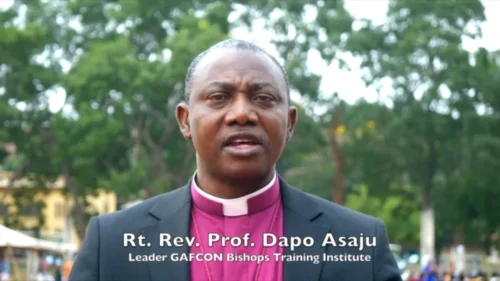
Delivering the keynote address, Bishop Dapo Asaju, Bishop of the Diocese of Ilesa and Bishop Theologian of the Anglican Church of Nigeria, described the prophetic office as a divine mandate deeply rooted in Scripture.
According to him, prophets historically acted as moral guardians who warned leaders, challenged injustice, and guided societies toward righteousness.
“Prophets are raised for specific generations. Their role is to warn, to intercede, and to guide nations toward righteousness,” Asaju said.
He warned that Nigeria’s ongoing socio-economic and political challenges partly reflect a lack of strong spiritual guidance.
The bishop also cautioned churches against becoming deeply involved in partisan politics, stressing that Christian influence must remain independent and morally grounded.
Primate Olabayo Praised as a Bold Prophetic Voice
Asaju also described Primate Theophilus Olabayo as a rare prophetic voice whose ministry has influenced Nigeria’s political and social landscape since he founded the Evangelical Church of Yahweh in 1973.
He noted that Olabayo’s direct and fearless prophetic style—often delivered without diplomatic restraint—helped shape the rise of media-driven prophetic Christianity in Nigeria.
Despite the risks involved, the primate remained outspoken on national issues and political transitions.
Scholars Call for Stronger Church Institutions
The Rector of the Crowther Graduate Theological Seminary and Professor of Church History, Prof. Rotimi Omotoye, urged the Evangelical Church of Yahweh to strengthen its legacy through institution building.
He emphasized that churches with lasting impact usually invest in education, healthcare, and structured social programs.
According to him, these institutions help sustain the influence of prophetic ministries beyond individual leadership.
Experts Emphasise Ethical Leadership and Governance
Also speaking at the event, Prof. Oluwayemisi Obashoro-John, Assistant Chaplain at the Chapel of Christ Our Light and lecturer at the University of Lagos, explored the church’s role as a moral watchman in society.
She stressed the importance of:
-
Strong internal governance
-
Ethical leadership
-
Institutional accountability within churches
Obashoro-John also encouraged Christian leaders to participate more actively in policy discussions—not as politicians, but as principled voices guiding national values.
Church Leaders Urge Reclaiming Independence Amid Partisanship in Nigeria
Other speakers at the event included Clement Isola Ojo, President and Rector of Trinity Faith Bible College and Seminary, and Bishop Enighokhana Oni, Overseer of the Evangelical Church of Yahweh Edo District.
The colloquium, themed “Shaping Prophetic and Spiritual Leadership for Global Impact,” ended with a collective call for Nigerian churches to reclaim their prophetic independence and moral courage.
Participants agreed that the credibility of Christian leadership does not depend on closeness to political power but on its ability to speak truth, demonstrate integrity, and contribute to Nigeria’s moral and social transformation.
